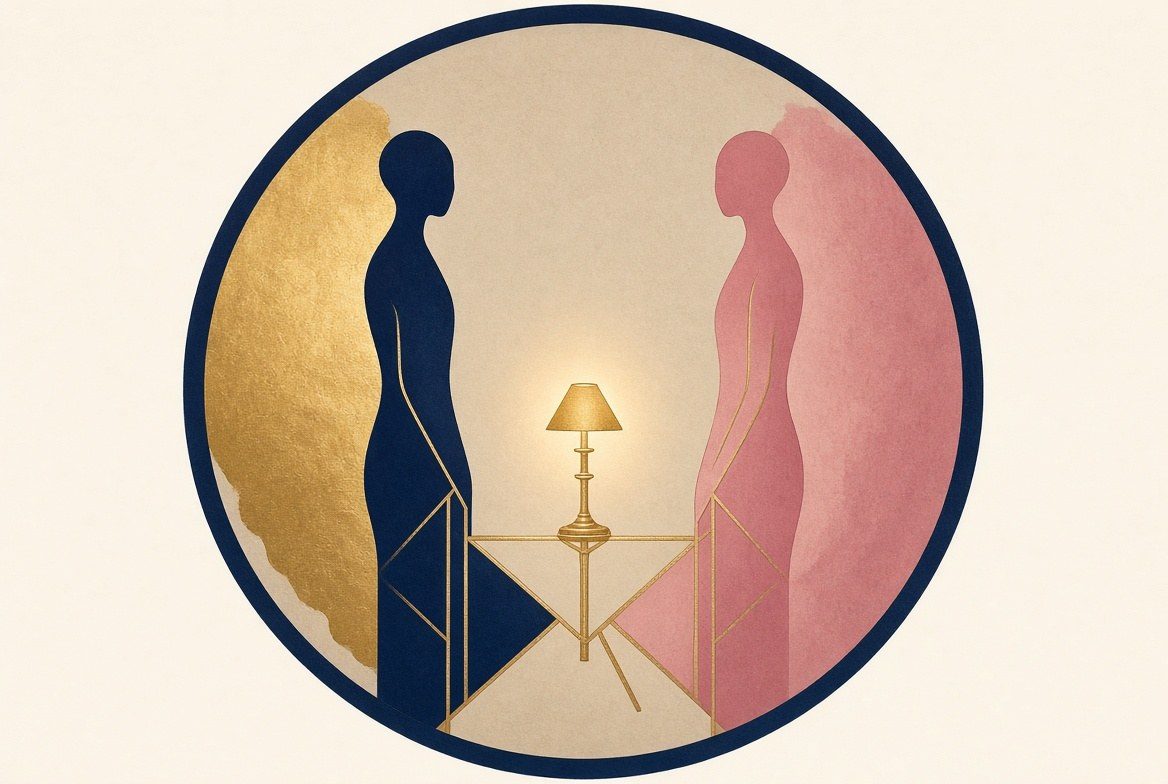
Two kinds of awareness
Nothing in this guide can be done blind. Before two can make a third, each has to see two things.
Self-awareness is knowing where you are standing: what you want, what you fear, what you are bringing into the room. Breath Awakens asks it as a question under the first Pillar of Humanity: "Where do I begin and where do I end?"
Situational awareness is seeing the other and the field: who is here, what they need, what is already moving between you, and what the place itself will bear. It is the reef's kind of knowing, and the starling's.
The two are not the same skill, and each fails in its own way. Self-awareness without the second becomes self-absorption. Situational awareness without the first becomes people-pleasing, or strategy. The Codex figure needs both: a centre found, and another allowed to stand.
Three ways of relating
The works define their terms with care, and the definitions are given here in their own words.
Extraction "is treating something as material for your own use rather than as a partner in something shared". It has two faces, which The Breathing Codex calls "the wall and the flood": taking by shutting out, and taking by swallowing.
Collaboration is working-with. The Codex treats it as the road and not the destination: "collaboration that leads to co-creation".
Co-creation is the third thing: "someone arrives with what you lacked, and together you make a third thing that belongs to neither".
The Codex of Play turns this from a moral into a measure. The difference, it says, is "between making that circulates and taking that accumulates". From that, One Breath, Read Whole drew three questions that can be asked of any relationship, at any scale.
- Where does it flow? Does what is made go round, or does it pile up in one place?
- What is at the centre? Is it kept open, or is someone sitting in it?
- Is there a third? Has something appeared that neither side could have made alone, and are both more alive for it?
What the first hand must say at once
Nature is not all collaboration. The living world holds predators, parasites and cheats, and they endure. Every one of the thirteen teachers in this guide has a shadow, and each is given.
Predation is not the same as extraction. A wolf takes a deer and stays inside the limits that keep both alive. Extraction, in the Codex sense, is taking past the boundary: faster than the whole can return.
No one is one thing. The same hand takes on Monday and makes on Tuesday. These are directions of flow, not kinds of people.
Collaboration does not always win. One Breath, Read Whole found that this claim does not hold as proof. What the works do show is narrower and sturdier: taking cannot make a third.
The Two Fours, and the Four Laws
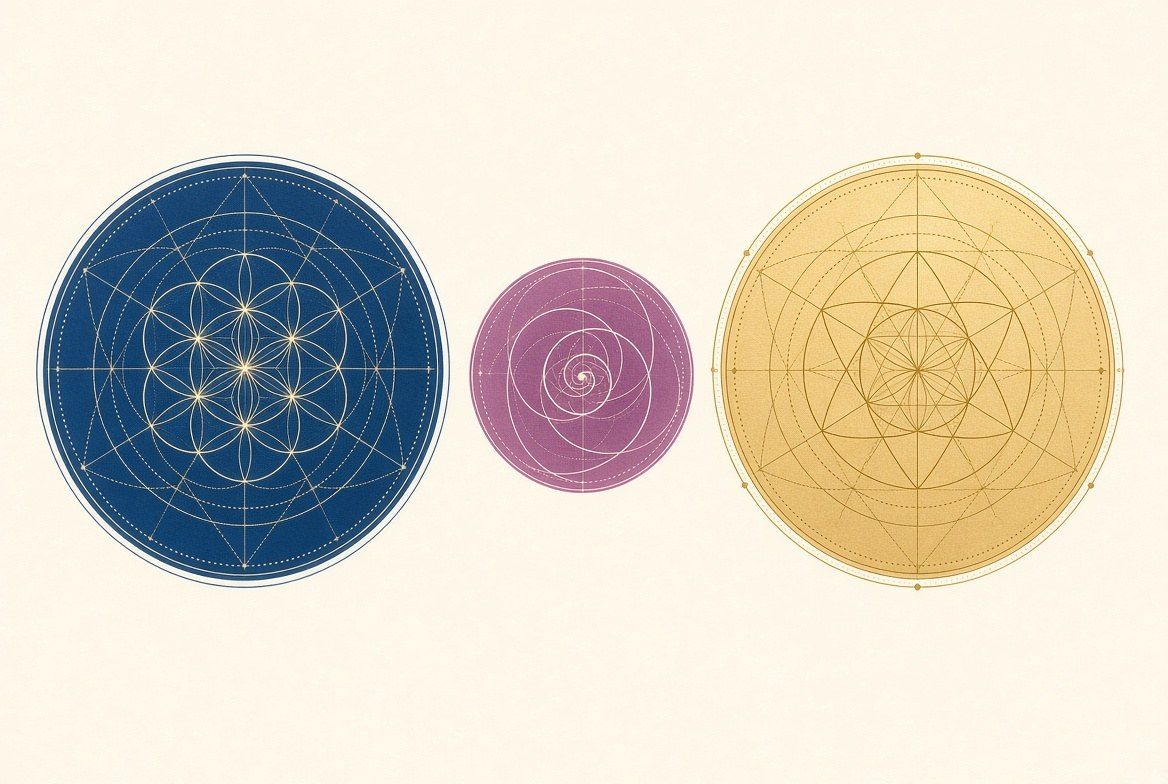
Breath Awakens gives two sets of four pillars. The Four Pillars of Breath are the movements of one breath, and they are inward. The Four Pillars of Humanity are how a person stands among others, and they are outward. The Codex of Play adds that the Four Laws of Creation "are the four movements of the breath".
Set side by side, by the four weeks of every Codex Moon:
| Week | Pillar of Breath | Pillar of Humanity | Law of Creation | What is practised |
|---|---|---|---|---|
| --- | --- | --- | --- | --- |
| 1 | Identify. "I see this. I name this." | Sovereignty. "This is not control." | Memory | Self-awareness |
| 2 | Accept. "I allow this to be true." | Adaptability. "This is not flexibility." | Unity through Diversity | Situational awareness |
| 3 | Embrace. "I bring this into my field." | Beauty. "This is not appearance." | Embodiment | Collaboration |
| 4 | Let Go. "I no longer hold this as mine." | Coherence. "This is not agreement." | Completion | Co-creation |
Read across a row and the theme of the whole Codex appears: the inner movement and the outer stance are the same act. To identify is to find your own centre, which is sovereignty. To accept is to let the other be as they are, which asks adaptability. To embrace is to enter the shared space, where beauty is seen "in the existence of another, even when incomplete". To let go is to leave the third free, and coherence is what holds when no one is holding.
"The inner world reflects the outer"
This sentence is the hinge of the site to come, and it deserves both hands.
| Sense | Grade | Note |
|---|---|---|
| --- | --- | --- |
| What we attend to and expect shapes what we notice | established | A large body of work in the psychology of perception and attention |
| We often see in others what we have not accepted in ourselves | well supported | Studied as projection and attribution; not every dislike is projection |
| A body is itself a community of many kinds of life | established | Moon XI |
| Changing one's inner state changes the outer world directly | not supported | It changes what one does, and that changes things |
| Inner and outer are one pattern at two scales | symbolic | The Codex reading |
The near-truth is practical. The surest way to change how you meet the world is to see how you are meeting yourself, and the surest test of inner work is what it makes between you and someone else.